blog/
3PL basics
How a 3PL Simplifies a Growing eCommerce Operation
Practical articles for online retailers who want to understand 3PL, improve fulfilment and know when it is time to hand over the work after checkout.
By
3PL Melbourne
Date
Aug 2026
Read time
5 minutes
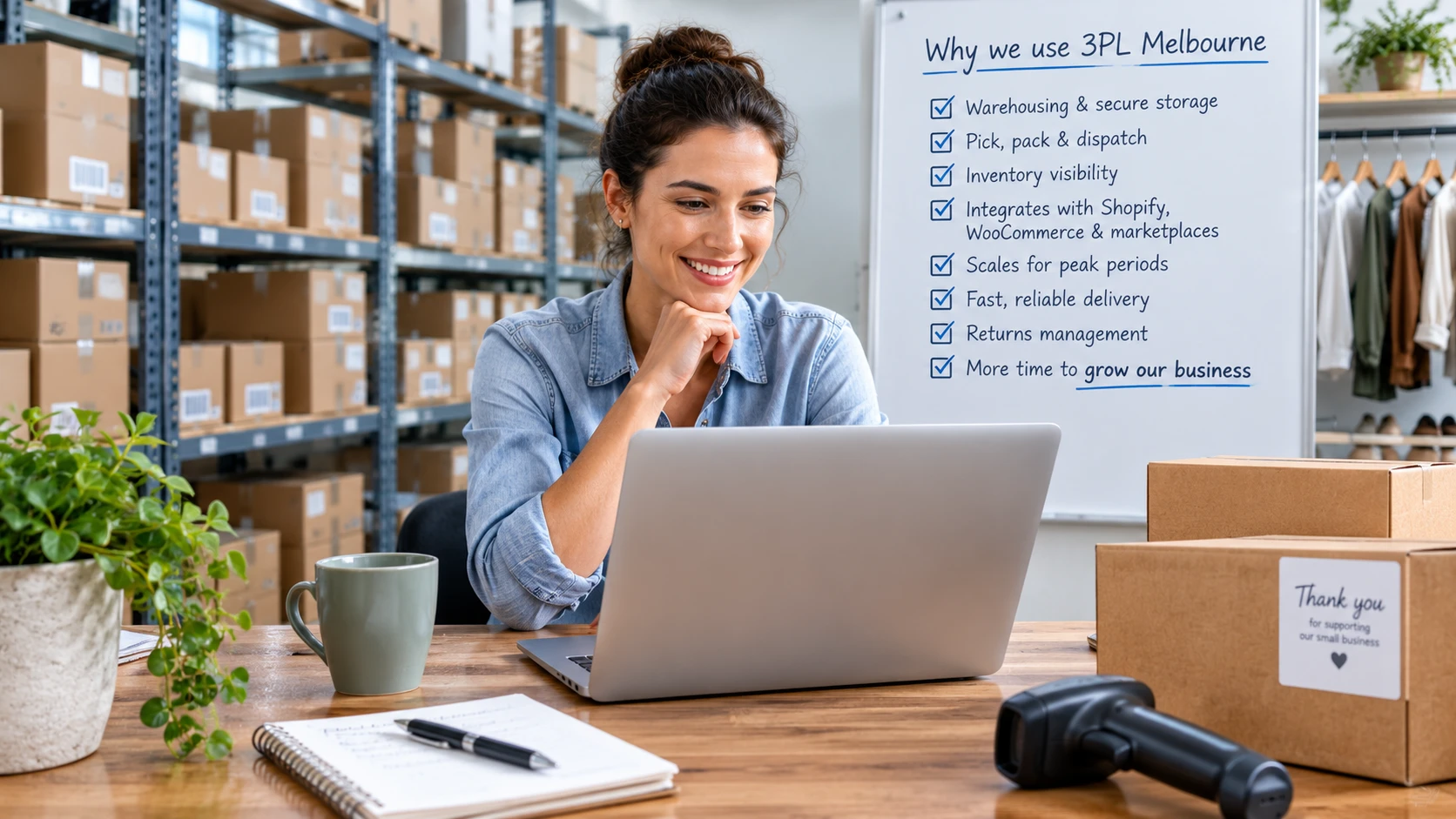
Growth is a positive sign for any eCommerce business.
More customers, more orders and a wider product range usually mean the business is moving in the right direction. But growth also introduces a level of operational complexity that is easy to underestimate.
What once involved storing a few cartons, packing a manageable number of orders and arranging occasional deliveries can quickly become a much larger operation. Stock needs to be tracked accurately. Orders may arrive through several sales channels. Packing instructions become more detailed. Returns increase. Delivery expectations rise. Internal teams spend more time resolving operational issues and less time working on the parts of the business that create growth.
This is where third-party logistics, commonly known as 3PL, can make a significant difference.
A good 3PL provider does more than store products and dispatch parcels. It brings warehousing, inventory management, order fulfilment, freight, returns and reporting into one coordinated operation.
The result is a simpler and more scalable logistics model that allows the retailer to retain visibility and control without managing every physical task internally.
Growth creates more than additional orders
When an eCommerce business grows, it rarely adds only more sales.
Growth may also involve:
- more products and stock-keeping units;
- higher inventory levels;
- additional suppliers;
- new sales channels;
- more complex packing requirements;
- greater demand for fast delivery;
- more returns and exchanges;
- seasonal promotions;
- additional customer service enquiries;
- new reporting and forecasting needs.
Each new layer affects the fulfilment operation.
For example, a business that previously sold 20 products through one website may expand into a much larger range across Shopify, online marketplaces, wholesale customers and retail partners.
The warehouse then needs to know:
- which channel generated each order;
- which stock is available to sell;
- which packing instructions apply;
- whether branded inserts should be included;
- which delivery service should be used;
- how stock movements should be recorded;
- what happens when an item is returned.
Without the right systems and processes, the business can quickly become dependent on spreadsheets, manual checks and individual staff members who hold important operational knowledge in their heads.
That approach may work at a small scale, but it becomes increasingly difficult to sustain as order volumes and product complexity increase.
A 3PL brings several functions into one operation
The role of a third-party logistics provider is to manage the physical movement of products from the point they enter the warehouse through to delivery to the customer.
Depending on the service arrangement, this can include:
- receiving incoming stock;
- checking deliveries against supplier documentation;
- storing products securely;
- recording inventory;
- processing customer orders;
- picking the correct products;
- packing orders according to agreed instructions;
- applying labels and preparing shipping documentation;
- arranging freight;
- providing tracking information;
- receiving and assessing returns;
- reporting on stock and order activity.
When these functions are handled through one coordinated operation, there are fewer gaps between separate suppliers and processes.
The retailer does not need to manage one provider for storage, another for packing, several carriers for delivery and a separate internal process for returns.
Instead, the 3PL provider becomes a central operational partner.
This can make communication clearer, reduce unnecessary hand-offs and create stronger accountability across the fulfilment process.
Fewer hand-offs can reduce errors
Every hand-off creates another opportunity for information to be delayed, misunderstood or lost.
For example, a retailer may send stock to one warehouse, provide order files to another supplier, arrange freight through a separate carrier and manage returns internally.
If a customer receives the wrong product, it may be difficult to determine where the error occurred.
Was the stock labelled incorrectly when it arrived? Was the wrong item picked? Was the correct parcel sent with the wrong shipping label? Was the return processed against the wrong order?
An integrated 3PL operation makes it easier to trace the movement of stock and orders through the warehouse.
The same provider can see:
- when stock was received;
- where it was stored;
- which order requested it;
- when it was picked;
- who packed it;
- when it was dispatched;
- what tracking information was assigned;
- whether the item was later returned.
This does not mean mistakes can never occur. No fulfilment operation can realistically promise that.
However, better visibility and fewer hand-offs can make problems easier to identify, investigate and resolve.
Multiple sales channels need one reliable fulfilment process
Many retailers now sell through more than one channel.
Orders may come from:
- a primary eCommerce website;
- Shopify;
- WooCommerce;
- online marketplaces;
- retail partners;
- wholesale customers;
- campaign landing pages;
- social commerce;
- subscription programs.
Each sales channel may have different order volumes, customer expectations and fulfilment requirements.
The complexity arises when all of these channels draw from the same inventory.
Without accurate stock information, the business may sell the same item in several places even though only one unit remains available. This can lead to overselling, cancelled orders and disappointed customers.
A connected 3PL operation can help by bringing orders into a warehouse management system and updating stock as products are allocated and dispatched.
Where appropriate integrations are available, orders can flow directly from the sales platform into the fulfilment process.
This reduces the need for manual data entry and helps prevent orders from being:
- missed;
- duplicated;
- delayed;
- entered incorrectly;
- processed against unavailable stock.
The retailer gains a more consistent fulfilment process, even when orders come from several different sources.
Better inventory visibility supports the entire business
Inventory accuracy is not only a warehouse issue.
It affects marketing, purchasing, sales, finance and customer service.
If stock information is unreliable, the business may:
- advertise unavailable products;
- reorder too late;
- purchase more stock than necessary;
- tie up cash in slow-moving inventory;
- provide inaccurate information to customers;
- lose sales because available stock cannot be located;
- carry obsolete products for too long.
A professional 3PL provider should maintain structured processes for receiving, storing and counting stock.
When products arrive at the warehouse, they may be:
- checked against the delivery documentation;
- counted;
- scanned into the warehouse system;
- assigned to a storage or picking location;
- separated if damaged or incomplete;
- recorded as available once receiving is complete.
The retailer should then be able to access useful inventory information, such as:
- stock on hand;
- available stock;
- allocated inventory;
- incoming stock;
- low-stock items;
- stock movements;
- returned stock;
- damaged or quarantined items.
This information enables better decisions.
Marketing teams can plan campaigns around actual availability. Purchasing teams can identify when stock needs to be reordered. Customer service teams can answer questions more confidently. Management can see which products are moving and which are occupying space without generating sales.
Reliable fulfilment protects the customer experience
The warehouse may operate behind the scenes, but the customer experiences the result directly.
Customers notice whether:
- the correct product arrives;
- the order is dispatched promptly;
- the parcel arrives in good condition;
- tracking information is clear;
- the packaging reflects the brand;
- returns are easy to manage.
They generally do not distinguish between the retailer, the warehouse and the delivery carrier.
If the wrong item arrives, the customer holds the brand responsible.
If the parcel is damaged, the brand’s reputation is affected.
If a return is slow or confusing, the customer may decide not to purchase again.
This means fulfilment is part of the brand experience.
A good 3PL provider understands that it is not simply moving cartons. It is handling products and customer orders on behalf of another business.
That requires accuracy, consistency and care.
Packing instructions need to become repeatable processes
Many eCommerce brands want their parcels to feel considered and recognisable.
This may involve:
- branded cartons or satchels;
- tissue paper;
- stickers;
- thank-you cards;
- product samples;
- discount offers;
- care instructions;
- promotional inserts;
- gift wrapping;
- bundled products;
- handwritten-style notes.
These details can improve the customer experience, but they also create additional operational steps.
At low volume, the founder may remember exactly how every order should be packed.
At larger volumes, that knowledge needs to be translated into clear, repeatable instructions.
A 3PL provider may require documented packing rules that explain:
- which packaging format applies to each product;
- how items should be arranged;
- which inserts belong in which orders;
- how fragile products should be protected;
- how bundles should be assembled;
- how gift orders should be handled;
- whether invoices or prices should be included;
- what quality checks must be completed before dispatch.
Photographic packing guides can be useful where presentation is important.
The goal is to ensure that every order receives the intended treatment, regardless of which warehouse team member packs it or how busy the operation becomes.
Scalability helps businesses manage peaks in demand
Order volumes are rarely consistent throughout the year.
Retailers may experience sudden increases because of:
- Christmas;
- Black Friday and Cyber Monday;
- product launches;
- promotional campaigns;
- influencer activity;
- media coverage;
- clearance events;
- seasonal demand;
- entry into a new sales channel.
These increases can be difficult to manage internally.
The business may need to find temporary space, recruit and train staff, purchase more equipment and reorganise the packing operation while customer orders are already waiting.
A 3PL provider offers access to an existing warehouse, established systems and a broader operational workforce.
This creates more flexibility.
The retailer does not need to maintain enough permanent space and labour to handle the busiest week of the year during every quieter month.
However, scalability is not automatic.
The retailer still needs to communicate expected peaks and campaigns in advance.
The 3PL provider may need time to organise:
- additional labour;
- packaging materials;
- stock locations;
- carrier collections;
- promotional inserts;
- campaign-specific packing instructions;
- increased receiving capacity.
The stronger the communication and forecasting, the better the 3PL provider can prepare.
Freight management becomes easier to coordinate
Delivery is one of the most visible parts of the customer experience.
The correct freight service depends on several factors, including:
- parcel size;
- parcel weight;
- destination;
- required delivery speed;
- product value;
- tracking requirements;
- special handling needs;
- cost.
Managing this internally can become complicated, particularly when the business uses multiple carriers or ships to metropolitan, regional and remote locations.
A 3PL provider can help coordinate freight and select suitable delivery services for different order types.
Established providers may also have access to more competitive freight rates because they combine parcel volumes across several clients.
The lowest freight rate is not always the best option.
A delivery service that regularly causes delays, damage or poor tracking may create additional customer service work and replacement costs.
A good 3PL relationship therefore considers the total delivery outcome, including:
- cost;
- reliability;
- tracking;
- service coverage;
- delivery time;
- claims handling;
- customer expectations.
Returns should be part of the fulfilment process
Returns are often treated as a separate inconvenience, but they are an important part of eCommerce logistics.
A returned product needs to be:
- received;
- identified;
- linked to the original order;
- assessed;
- recorded;
- restocked, reviewed or quarantined;
- reported to the retailer.
Without a defined process, returns can sit unprocessed, disappear from stock records or cause delays in issuing refunds and replacements.
A 3PL provider can manage returns according to agreed instructions.
For example, the provider may separate items into:
- suitable for immediate restocking;
- requiring inspection;
- damaged;
- incomplete;
- unsuitable for resale;
- awaiting retailer direction.
The retailer gains better visibility over what has been returned and what action has been taken.
Returns data can also reveal useful patterns.
Repeated returns may indicate:
- inaccurate product descriptions;
- sizing problems;
- poor packaging;
- recurring product damage;
- incorrect items being picked;
- supplier quality issues.
When returns are connected to the broader fulfilment operation, the business has a clearer view of what is happening across the complete customer journey.
Clear accountability makes problems easier to resolve
No logistics operation is completely free from exceptions.
Stock may arrive late. A supplier may send the wrong quantity. A product may be damaged. A courier may miss a collection. A customer may enter the wrong address.
The important issue is not whether exceptions occur, but how they are managed.
A strong 3PL provider should offer:
- a clear point of contact;
- timely communication;
- transparent reporting;
- documented escalation processes;
- ownership of agreed responsibilities;
- practical recommendations;
- corrective action when errors occur.
The retailer should know who is responsible for each stage of the process and what happens when something goes wrong.
A good provider should also identify risks before they become customer problems.
For example, the warehouse team may notice that:
- two similar products are frequently confused;
- a carton is too large and is increasing freight costs;
- an insert is almost out of stock;
- a product is being damaged in storage;
- a promotional campaign is likely to exceed available inventory;
- a supplier is repeatedly sending incorrect quantities.
This proactive input is one of the differences between a basic warehouse service and a genuine logistics partner.
Technology should make logistics easier to manage
Technology is central to modern 3PL operations, but it should support the business rather than overwhelm it.
Useful systems may assist with:
- order integrations;
- inventory records;
- barcode scanning;
- picking;
- dispatch;
- tracking;
- low-stock alerts;
- returns;
- reporting.
The retailer does not necessarily need the most advanced or complicated platform available.
It needs a system that is suitable for its products, order volumes and sales channels.
The technology also needs to be supported by disciplined warehouse processes.
A system can record where stock should be stored, but warehouse staff still need to place it correctly.
It can generate a picking instruction, but the picker still needs to scan and verify the product.
It can provide a low-stock alert, but the retailer still needs to make the purchasing decision.
The best results come from combining appropriate technology with experienced people and clear processes.
Outsourcing should create more control, not less
Some businesses worry that outsourcing fulfilment will reduce their control.
That concern is understandable.
Inventory and customer orders are critical parts of the business, and the retailer needs confidence that both are being handled properly.
A well-run 3PL relationship should create clearer control through:
- defined processes;
- agreed service standards;
- inventory reporting;
- order visibility;
- documented packing rules;
- regular communication;
- performance reviews;
- clear responsibility.
The retailer should remain involved in forecasting, purchasing, product decisions and customer strategy.
The 3PL provider manages the physical execution.
This division allows each party to focus on what it does best.
How to choose a 3PL that genuinely reduces complexity
Not every provider will be suitable for every business.
The right partner should understand the retailer’s products, sales channels, service expectations and growth plans.
When comparing providers, consider questions such as:
- Does the provider have experience with similar products?
- Can it integrate with our eCommerce platform?
- How is incoming stock checked and recorded?
- What inventory information will we be able to access?
- How are orders picked and verified?
- Can the provider follow brand-specific packing instructions?
- How are promotional campaigns managed?
- What happens during peak periods?
- Which freight services are available?
- How are returns processed?
- Who will manage our account?
- How are errors investigated?
- What reporting is available?
- Are all fees explained clearly?
- Can the provider support future growth?
Price is important, but it should not be considered in isolation.
A low-cost service may become expensive if it results in poor stock control, fulfilment errors, slow communication or unhappy customers.
The right provider should offer a commercially sensible balance of cost, capability, visibility and service.
When is it time to consider a 3PL?
There is no single order-volume threshold that applies to every business.
The decision depends on the products, margins, storage requirements, internal resources and growth plans.
However, it may be time to consider outsourcing when:
- stock is taking over the home, office or shop;
- the team spends too much time packing orders;
- dispatch deadlines are regularly missed;
- inventory is difficult to track;
- more warehouse space is required;
- seasonal peaks are becoming unmanageable;
- fulfilment errors are increasing;
- the business needs better reporting;
- customer service teams lack order visibility;
- growth is being limited by internal logistics capacity.
The business should compare the total cost of internal fulfilment with the total cost of outsourcing.
That comparison should include not only rent and labour, but also:
- management time;
- systems;
- equipment;
- insurance;
- recruitment;
- training;
- packaging;
- freight administration;
- stock errors;
- damaged products;
- replacement orders;
- customer complaints;
- missed growth opportunities.
Make growth easier to manage
A growing eCommerce business will always involve complexity.
More products, customers and sales channels naturally create more moving parts.
The purpose of a 3PL provider is not to pretend that this complexity disappears. It is to organise and manage it through better systems, processes, infrastructure and accountability.
By bringing warehousing, inventory management, order fulfilment, freight and returns into one coordinated operation, the right 3PL partner can make the business easier to run.
The retailer gains more visibility, greater flexibility and more time to focus on product development, marketing, customer relationships and growth.
3PL Melbourne provides secure warehousing, inventory management, eCommerce fulfilment, pick and pack, freight and returns support for established online retailers.
Call 1300 337 100 to discuss how we can simplify your eCommerce logistics operation.
More fulfilment guides
Keep reading
Related articles and useful next reads for online retailers learning how fulfilment works.
3PL basics, How 3PL Works, Outsourcing Fulfilment