
blog/
Outsourcing Fulfilment, Scaling operations
What Australia’s Growing 3PL Market Means for eCommerce Entrepreneurs
Practical articles for online retailers who want to understand 3PL, improve fulfilment and know when it is time to hand over the work after checkout.
By
3PL Melbourne
Date
Aug 2026
Read time
5 minutes
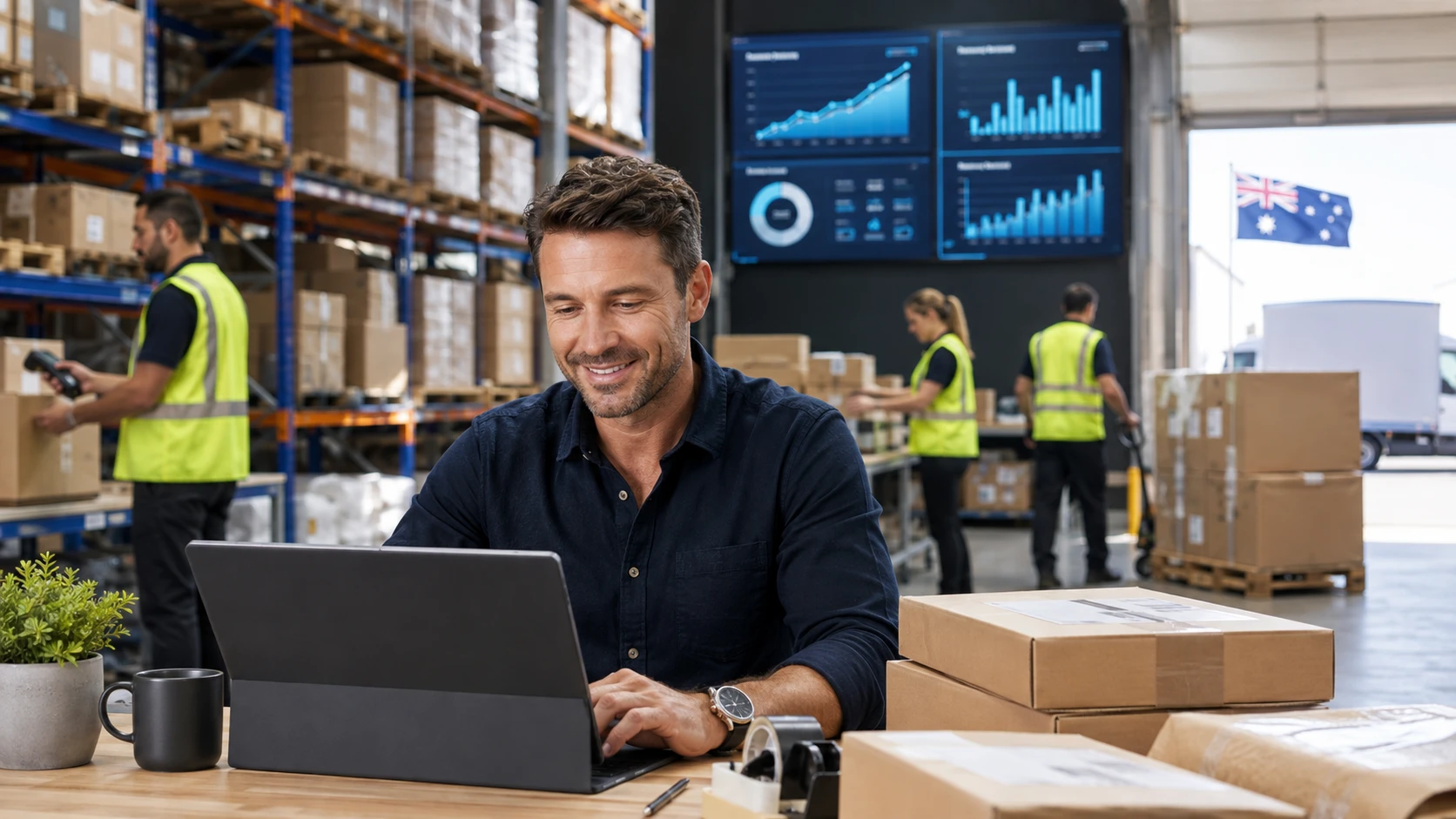
Australia’s third-party logistics market is expected to continue growing strongly over the next decade.
Recent research published by Expert Market Research estimates that the Australian 3PL market was worth approximately A$199.5 billion in 2025 and could reach around A$344.02 billion by 2035, representing forecast annual growth of 5.6% between 2026 and 2035. The research attributes this growth to increasing demand for specialist logistics expertise, technology, scalable warehousing, distribution and value-added services.
For Australian eCommerce entrepreneurs, the significance of this forecast is not simply that the logistics industry is becoming larger.
It reflects a broader change in how growing online businesses manage stock, fulfil customer orders and build the operational capability needed to scale.
More businesses are recognising that warehousing and fulfilment do not necessarily need to be built and managed internally. Instead, they can partner with an experienced third-party logistics provider and gain access to established infrastructure, systems and people.
So, what does the future of 3PL mean for Australian eCommerce businesses?
3PL is becoming part of the growth strategy
Third-party logistics was once viewed mainly as a transport and storage service.
A business sent stock to a warehouse, and the warehouse arranged for products to be dispatched when required.
That remains part of the service, but modern 3PL is far broader.
A third-party logistics provider may now manage:
- stock receiving;
- warehousing;
- inventory records;
- eCommerce integrations;
- order processing;
- pick and pack;
- packaging;
- freight;
- tracking;
- returns;
- kitting;
- labelling;
- reporting.
Expert Market Research identifies warehousing and distribution, transportation management and value-added logistics services among the major segments of the Australian 3PL market. It also points to increasing outsourcing of logistics activities as a factor supporting market growth.
For eCommerce entrepreneurs, this means 3PL should not be treated only as a solution for parcels that have become difficult to manage.
The right logistics partner can form part of the business’s long-term operating model.
It can provide the structure needed to support more orders, more products and more sales channels without requiring the retailer to create an entire warehouse operation from the ground up.
Growing businesses need scalable capacity
One of the central themes in the research is scalability.
3PL providers allow businesses to adjust logistics resources as demand changes, rather than maintaining the same level of warehouse space and labour throughout the year.
This is particularly relevant for eCommerce businesses because demand can change quickly.
Order volumes may increase because of:
- Christmas trading;
- Black Friday and Cyber Monday;
- a product launch;
- a successful advertising campaign;
- influencer or media exposure;
- seasonal demand;
- a new marketplace or retail partner.
A business managing fulfilment internally may need to recruit temporary staff, lease additional space and purchase new equipment to cope with a short-term spike.
That capacity can then become expensive during quieter periods.
A 3PL model gives the retailer access to established warehouse infrastructure and a flexible operational workforce.
This does not remove the need for forecasting or communication. A 3PL provider still needs advance notice of promotions, product launches and likely peaks.
However, it gives the business a stronger base from which to respond.
For entrepreneurs, the practical benefit is that fulfilment capacity can grow with the business instead of continually holding it back.
Warehousing is becoming more connected
The future of 3PL is not just about larger warehouses.
It is about more connected operations.
As businesses sell through multiple channels, warehouse systems need to receive orders, update inventory and return dispatch information efficiently.
An eCommerce business may sell through:
- its own online store;
- Shopify;
- WooCommerce;
- online marketplaces;
- retail partners;
- wholesale accounts;
- subscription programs;
- campaign landing pages.
Each channel may generate orders differently, but the warehouse still needs one reliable way to process them.
Where suitable integrations are available, orders can move directly from the sales platform into the warehouse management system.
The fulfilment team can then pick, pack and dispatch the order, while tracking information is returned to the retailer or customer.
This can reduce manual handling and help prevent orders from being:
- missed;
- duplicated;
- delayed;
- entered incorrectly;
- processed against unavailable stock.
For growing online retailers, connected inventory and order information will become increasingly important.
A warehouse that simply stores cartons without providing useful visibility will be less valuable than one that helps the retailer understand what is happening across stock, orders and returns.
Inventory visibility will become a basic expectation
Accurate inventory information affects far more than the warehouse.
It influences marketing, purchasing, customer service, finance and cash flow.
When stock information is unreliable, businesses can oversell products, reorder too late or tie up money in inventory that is not moving.
A structured 3PL operation should give the retailer clearer visibility over:
- stock received;
- stock on hand;
- available inventory;
- allocated products;
- low-stock items;
- order status;
- dispatched orders;
- returned products;
- damaged or quarantined stock.
This information helps the retailer make better commercial decisions.
Marketing teams can plan promotions around actual stock availability. Purchasing teams can identify when products need to be reordered. Customer service teams can give customers more accurate information.
Expert Market Research identifies inventory management and timely order fulfilment as important factors behind demand for warehousing and distribution services.
For entrepreneurs, this means the value of a 3PL partner will increasingly depend on the quality of information it provides, not only the amount of stock it can hold.
Value-added services will become more important
The research identifies value-added logistics services as a growth area within the Australian market. These services can include activities such as kitting, labelling and other customised handling requirements.
This is significant for eCommerce brands because fulfilment is rarely completely standard.
A retailer may need the warehouse to:
- assemble product bundles;
- prepare promotional kits;
- apply new labels;
- include samples;
- insert campaign material;
- repackage stock;
- prepare subscription boxes;
- handle gift orders;
- separate returned products;
- customise presentation.
These services allow the warehouse to support marketing and customer experience activity, not only storage and dispatch.
For example, a business launching a seasonal promotion may need several products assembled into one kit, packed in a specific order and dispatched with a printed insert.
A retailer selling through different channels may require different labels or packaging depending on where the order originated.
The ability to manage these requirements consistently is likely to become increasingly valuable.
It also highlights why eCommerce businesses should choose a 3PL provider based on operational fit, rather than comparing only the lowest pick-and-pack price.
Customer expectations will continue to shape fulfilment
The research links demand for 3PL services with eCommerce growth and the need for timely delivery and efficient order fulfilment.
Customers increasingly expect:
- accurate orders;
- clear tracking;
- appropriate packaging;
- reasonable delivery times;
- simple returns;
- reliable communication.
They do not usually separate the retailer from the warehouse or freight provider.
If a parcel arrives late, damaged or incorrect, the customer holds the brand responsible.
This makes fulfilment part of the customer experience.
As the 3PL market develops, online businesses should expect more logistics providers to compete not only on cost, but also on:
- order accuracy;
- inventory visibility;
- delivery performance;
- responsiveness;
- packaging capability;
- returns processing;
- customer reporting.
For entrepreneurs, this is an important shift.
The warehouse is not simply a backend supplier. It is responsible for executing a visible part of the brand promise.
Specialist fulfilment will matter more
The research divides 3PL demand across sectors including manufacturing, retail, healthcare and automotive.
Different products create different logistics requirements.
Apparel may require size and colour accuracy. Beauty products may need careful batch or expiry management. Technology products may require secure storage. Gift items may need presentation-led packaging. Healthcare products may involve stricter handling processes.
Even within eCommerce, there is no single fulfilment model that suits every business.
As demand for outsourced logistics increases, specialist capability is likely to become more important.
Retailers should consider whether a provider understands:
- the product category;
- the order profile;
- storage requirements;
- packaging expectations;
- returns behaviour;
- seasonal demand;
- customer service standards.
A 3PL provider with suitable experience can help identify risks and establish more effective processes from the beginning.
Outsourcing can reduce pressure on internal teams
As online businesses grow, founders and internal staff often spend increasing amounts of time on fulfilment.
They may be:
- receiving supplier deliveries;
- reorganising stock;
- packing orders;
- printing labels;
- chasing freight;
- answering delivery enquiries;
- counting inventory;
- handling returns.
These tasks are necessary, but they may not be the best use of the team’s time.
Outsourcing allows internal resources to focus more closely on:
- product development;
- marketing;
- customer acquisition;
- sales;
- supplier management;
- brand development;
- customer retention.
This is one of the most important reasons why growth in the 3PL market matters to entrepreneurs.
It suggests more businesses are separating logistics execution from the core commercial work of running the brand.
The retailer retains control over products, pricing, marketing and customer strategy.
The logistics provider manages the physical operation required to deliver the orders.
Sustainability will become a greater consideration
Expert Market Research also points to sustainable warehousing as an emerging area of focus, including facilities using initiatives such as solar energy, efficient lighting and water conservation.
For eCommerce businesses, sustainability considerations may extend beyond the warehouse itself.
They can also include:
- reducing oversized packaging;
- minimising unnecessary void fill;
- using recyclable materials;
- reducing damaged goods;
- consolidating deliveries;
- improving inventory planning;
- avoiding obsolete stock;
- selecting more efficient freight options.
The future challenge will be balancing environmental objectives with product protection, presentation, cost and delivery performance.
A package that uses less material but fails to protect the product may create more waste through replacement stock and repeat delivery.
The strongest approach is likely to be practical rather than cosmetic: using appropriate materials, reducing avoidable waste and improving the efficiency of the complete fulfilment process.
3PL providers will be expected to offer more than space
As the market grows, the expectations placed on 3PL providers will also increase.
A retailer will increasingly look for a partner that can provide:
- secure storage;
- accurate stock control;
- platform integrations;
- scalable fulfilment;
- clear reporting;
- value-added services;
- returns management;
- responsive account support;
- freight coordination;
- practical advice.
In other words, the future of 3PL is likely to be less transactional.
Businesses will want providers that understand how fulfilment fits into the wider operation.
The provider should be able to explain what is happening, identify risks and help the retailer prepare for growth.
What should eCommerce entrepreneurs do now?
The forecast does not mean every online business needs to outsource fulfilment immediately.
There is no universal order-volume threshold at which a 3PL becomes the right answer.
However, entrepreneurs should regularly assess whether their current operation can support the next stage of the business.
It may be time to explore 3PL when:
- stock is taking over the office, shop or home;
- packing orders consumes too much time;
- inventory is becoming difficult to track;
- dispatch deadlines are being missed;
- peak periods are hard to manage;
- the business needs additional warehouse space;
- more staff would need to be hired;
- fulfilment mistakes are increasing;
- growth is limited by operational capacity;
- the business needs better reporting.
The decision should consider the full cost of internal fulfilment.
This includes warehouse space, labour, equipment and freight, but also management time, errors, delays, damaged stock and missed opportunities.
The future of Australian 3PL is about enabling growth
Expert Market Research’s forecast points to continued expansion in Australian third-party logistics over the next decade. While the exact figures are forecasts, the underlying direction is clear: more businesses are looking for scalable warehousing, fulfilment, technology and specialist logistics support.
For Australian eCommerce entrepreneurs, this creates both an opportunity and a challenge.
The opportunity is to access logistics capability that would be expensive and difficult to build internally.
The challenge is choosing a provider that can support the business properly.
The right 3PL partner should make growth easier to manage. It should provide clearer inventory visibility, reliable order fulfilment, flexible capacity and the operational support needed to protect the customer experience.
3PL Melbourne provides secure warehousing, inventory management, eCommerce fulfilment, pick and pack, freight, returns and value-added logistics support for established online retailers.
Call 1300 337 100 to discuss how your fulfilment operation can support the next stage of your business.
More fulfilment guides
Keep reading
Related articles and useful next reads for online retailers learning how fulfilment works.
3PL basics, How 3PL Works, Outsourcing Fulfilment