
blog/
3PL basics, Entrepreneurs
From Instagram Ad to Customer Delivery: Is Your Fulfilment Ready?
Practical articles for online retailers who want to understand 3PL, improve fulfilment and know when it is time to hand over the work after checkout.
By
3PL Melbourne
Date
Aug 2026
Read time
5 minutes
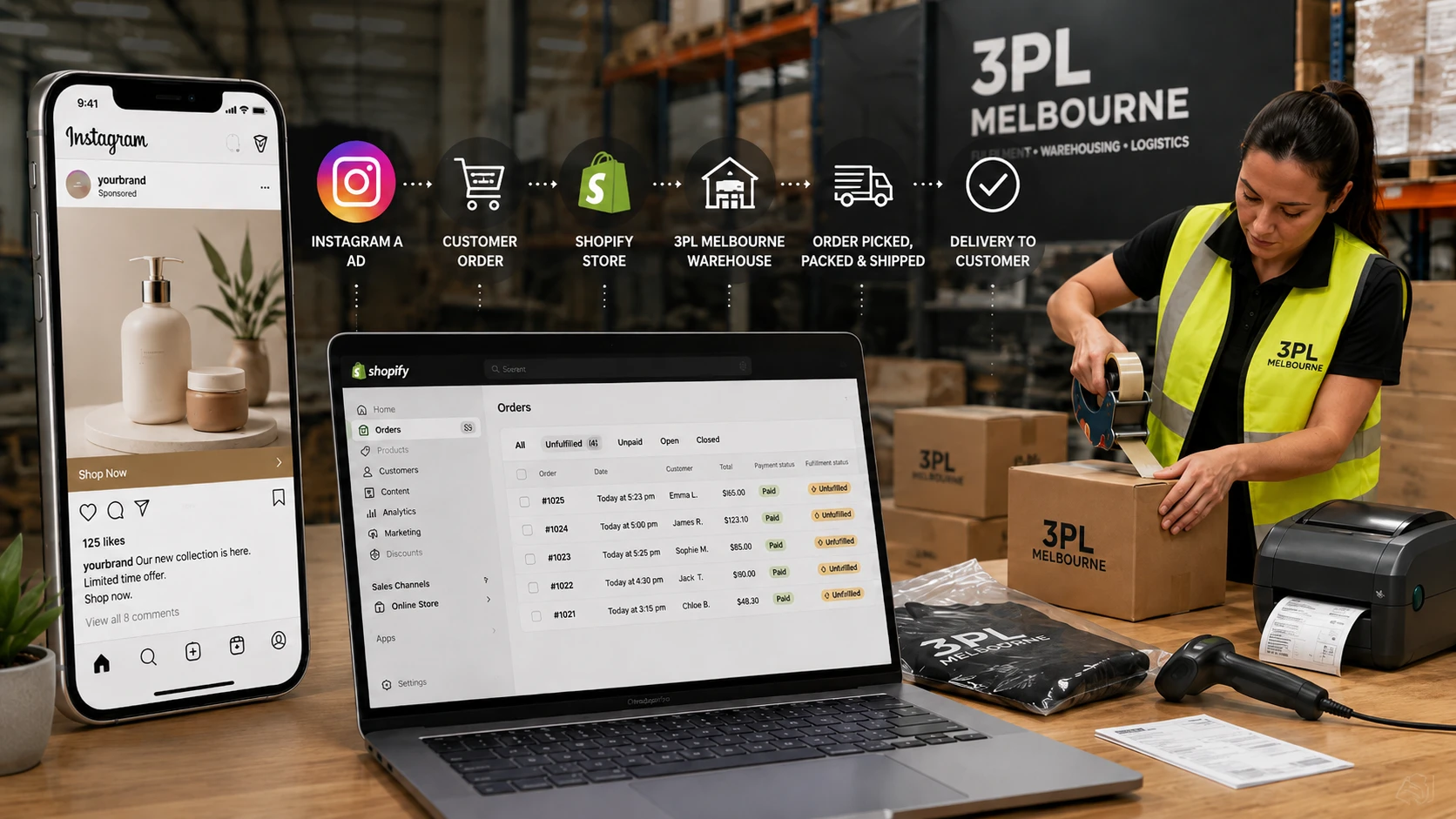
Instagram can generate demand quickly.
A strong product image, well-targeted advertisement or successful creator collaboration can send large numbers of people to an online store within a short period of time. For an eCommerce business, that kind of attention can be valuable.
But advertising success creates an immediate operational question:
Can the business fulfil the orders properly?
Generating sales is only the first part of the customer journey. Products still need to be available, picked accurately, packed correctly and dispatched on time.
If fulfilment is not prepared, a successful Instagram campaign can lead to:
- overselling;
- delayed dispatch;
- stock discrepancies;
- rushed packing;
- missing promotional items;
- increased customer enquiries;
- returns and complaints;
- damage to the brand.
Instagram advertising should therefore be planned with fulfilment in mind.
The marketing team may control the creative, audience and budget, but the warehouse ultimately determines whether the business can deliver what the advertisement promised.
Instagram can create demand faster than operations can respond
Traditional marketing campaigns often give businesses time to observe demand building gradually.
Instagram can operate differently.
A paid campaign, popular Reel or creator post may generate a sudden increase in:
- website traffic;
- product views;
- cart activity;
- customer orders;
- direct messages;
- delivery enquiries.
Meta Ads Manager also allows businesses to run more sophisticated campaigns than a basic boosted post, with greater control over audiences, placements and campaign structure.
That can help the business reach more potential customers, but it also means demand may rise faster than expected.
A campaign should not be treated as a marketing activity that ends when the customer clicks the advertisement.
It creates work across:
- inventory;
- warehousing;
- order processing;
- packing;
- freight;
- customer service;
- returns.
The stronger the campaign performs, the greater the pressure on those parts of the business.
Start with accurate inventory
Before increasing advertising spend, confirm that the advertised products are physically available.
This sounds obvious, but inventory data can become unreliable when stock is:
- held across several locations;
- sold through multiple channels;
- reserved for wholesale customers;
- included in bundles;
- awaiting inspection after return;
- damaged or quarantined;
- recorded manually.
The quantity shown in the online store should reflect what is genuinely available to sell.
A product may physically exist in the warehouse without being ready for customer orders. Some units may already be committed, damaged or allocated elsewhere.
Before launching an Instagram campaign, review:
- current stock on hand;
- available stock;
- committed stock;
- incoming supplier deliveries;
- safety stock;
- expected campaign demand;
- supplier lead times.
This is especially important when the campaign is promoting one hero product.
If that product sells out immediately, the business needs a clear plan.
Will the advertisement be paused? Will customers be allowed to pre-order? Will a substitute product be promoted? Will the landing page be updated?
These decisions should be made before the campaign begins.
Do not advertise beyond your fulfilment capacity
A campaign budget should not be set without considering how many orders the operation can process.
For example, if the warehouse can comfortably dispatch 200 orders a day, a campaign expected to generate 1,000 orders in one weekend needs additional planning.
The business may need:
- more warehouse labour;
- additional packing stations;
- extra cartons or satchels;
- more frequent carrier collections;
- pre-assembled bundles;
- additional customer service support;
- extended dispatch timeframes.
Without preparation, the orders may accumulate faster than they can be packed.
This creates a backlog that affects both campaign customers and ordinary business-as-usual orders.
A 3PL provider can help by increasing operational capacity during a known campaign period, but it needs sufficient notice.
The provider should know:
- when the campaign starts;
- when it ends;
- which products are included;
- the expected order volume;
- whether there are bundles or gifts;
- which packaging should be used;
- whether express delivery is being promoted;
- whether any campaign-specific insert is required.
The warehouse cannot prepare properly if it first learns about the promotion when orders begin arriving.
Make sure the advertisement matches the stock
Instagram is highly visual.
Customers may purchase because of a particular colour, product combination, gift box or presentation shown in the advertisement.
The fulfilment operation must be able to reproduce what has been promised.
Before approving campaign creative, confirm:
- the featured product is the correct version;
- colours and variants match the live listing;
- the packaging shown is available;
- gift items or samples are in stock;
- bundles contain the correct components;
- campaign wording reflects the actual offer;
- delivery claims are realistic.
A customer who receives something different from the advertisement may feel misled, even when the main product is technically correct.
This is particularly important for:
- limited-edition packaging;
- gift-with-purchase campaigns;
- seasonal bundles;
- subscription offers;
- product samples;
- promotional kits.
Marketing creative and warehouse instructions should be developed together.
Prepare bundles before the campaign begins
Instagram campaigns often promote product bundles because they are visually appealing and can increase average order value.
A bundle may combine several individual products into one offer.
The warehouse then needs to know whether the bundle is:
- pre-assembled before the campaign;
- assembled only when ordered;
- packed as separate components;
- presented in a dedicated box;
- sold under one SKU or several component SKUs.
Each method has operational implications.
Pre-assembled bundles can make fulfilment faster during a campaign, but they require:
- advance labour;
- storage space;
- accurate component counts;
- finished-kit inventory;
- a plan for unused bundles.
Assembled-to-order bundles offer more flexibility, but they take longer to pick and pack.
The business should also understand which component limits the bundle’s availability.
If one item sells out, the entire bundle may become unavailable even when every other component remains in stock.
The bundle should be fully tested before advertising begins.
That test should confirm:
- order transmission;
- warehouse picking instructions;
- component inventory;
- packaging;
- parcel weight;
- shipping rates;
- tracking;
- returns handling.
Campaign inserts need operational control
Instagram advertising may be supported by physical campaign material inside the parcel.
This can include:
- a thank-you card;
- a discount code;
- a product sample;
- a referral offer;
- a catalogue;
- a care guide;
- a QR code;
- a campaign-specific message.
These additions can help turn a first-time customer into a repeat customer.
However, inserts create another inventory and process requirement.
The warehouse needs to know:
- which orders receive the insert;
- when inclusion begins;
- when it ends;
- how many inserts are available;
- where they are stored;
- what happens when stock runs out;
- whether different customers receive different versions.
An outdated discount code or incorrect sample can undermine the campaign.
The safest approach is to create simple, documented rules that the warehouse can follow consistently.
Confirm packaging materials are available
A successful campaign can use packaging stock faster than expected.
Businesses often forecast product inventory but overlook:
- cartons;
- mailers;
- protective materials;
- tape;
- labels;
- tissue paper;
- branded stickers;
- printed inserts.
If the correct packaging runs out halfway through the campaign, the business may need to substitute materials or delay dispatch.
Before launching, calculate how much packaging is likely to be required.
Allow for:
- forecast orders;
- larger multi-item orders;
- packing mistakes;
- damaged packaging;
- replacement orders;
- continued non-campaign sales.
The packaging should also be tested with the campaign product.
A new bundle may require a larger carton than the individual items normally use. That can affect freight cost and product protection.
Be careful with delivery promises
Fast-delivery claims can improve conversion, but they create an operational commitment.
Before promoting same-day or next-day dispatch, confirm that the full process can support it.
That includes:
- order cut-off times;
- warehouse processing capacity;
- stock availability;
- carrier collection schedules;
- delivery location;
- weekends and public holidays;
- campaign volume.
There is an important difference between:
- dispatching an order within one day; and
- guaranteeing that it will reach the customer the next day.
The retailer usually controls dispatch timing. The delivery carrier controls much of what happens afterwards.
Campaign wording should be precise.
Avoid making promises that depend on conditions the business cannot fully control.
If campaign volumes become higher than expected, communicate quickly.
It is better to provide a realistic revised timeframe than to leave customers wondering where their order is.
Connect Instagram demand to Shopify inventory
Many Instagram campaigns direct customers to a Shopify store.
Products promoted through Meta may also be managed through a product catalogue. Meta explains that a catalogue contains product information used to promote items across its technologies, while Advantage+ catalogue ads can automatically show people relevant products based on interests and actions.
This creates a direct relationship between:
- the Instagram campaign;
- the product catalogue;
- the Shopify store;
- warehouse inventory;
- the 3PL fulfilment process.
The information across these systems needs to remain aligned.
Check that:
- advertised products are active;
- prices are correct;
- images match the product;
- product links work;
- variants are mapped correctly;
- unavailable products are not being promoted;
- inventory updates are reaching the store;
- campaign landing pages are functioning.
A broken product link wastes advertising spend.
An incorrect stock status can create customer disappointment.
A catalogue showing outdated pricing can create confusion and additional service work.
The campaign should be tested from the customer’s perspective before going live.
Click the advertisement, visit the product page, select a variant, add it to cart and complete a test order.
Then confirm that the order reaches the warehouse correctly.
Test the entire order journey
Campaign preparation should not stop at the advertisement preview.
Run test orders that cover the most likely scenarios.
These might include:
- one promoted product;
- multiple promoted products;
- a campaign bundle;
- a gift-with-purchase order;
- an express order;
- an order using a discount code;
- an order with an unavailable component;
- an order from a regional destination;
- a cancellation;
- a return.
Check:
- the correct price;
- discount application;
- inventory reduction;
- order information received by the warehouse;
- packing instructions;
- shipping selection;
- tracking;
- customer notifications;
- return handling.
This is especially important when several systems are involved.
A campaign can appear correct in Instagram while failing later in Shopify, the warehouse integration or the delivery process.
Testing helps identify those gaps before customers do.
Prepare customer service for campaign questions
A campaign can increase customer enquiries as well as sales.
Questions may relate to:
- product suitability;
- sizing;
- stock availability;
- discount codes;
- delivery timing;
- address changes;
- tracking;
- returns;
- campaign terms.
Customer service teams should receive the campaign details before launch.
They need to understand:
- what is being promoted;
- the offer terms;
- campaign dates;
- excluded products;
- delivery expectations;
- stock limitations;
- returns rules;
- escalation contacts.
They should also have access to accurate order and tracking information.
When fulfilment visibility is poor, customer service teams are forced to contact the warehouse for every question.
A connected 3PL operation can make answers easier to obtain.
Plan what happens if the campaign overperforms
Every campaign plan should include a success scenario.
Ask:
- What happens if orders are double the forecast?
- How quickly can warehouse capacity increase?
- Is there enough stock?
- Can the carrier collect more parcels?
- Should advertising spend be reduced if a backlog forms?
- Which customers should receive priority?
- What communication will be sent about delays?
- Can campaign products be temporarily hidden when stock becomes low?
Meta campaigns may enter a learning phase while the delivery system determines how an ad set performs.
Performance can therefore change during the campaign.
The business should monitor not only advertising metrics, but also:
- order volume;
- stock remaining;
- fulfilment backlog;
- dispatch times;
- customer enquiries;
- cancellations;
- returns.
Marketing performance and operational performance should be reviewed together.
A campaign with strong sales but high cancellations, late delivery and customer complaints may not be commercially successful.
Returns can reveal campaign problems
Returns should be reviewed after an Instagram campaign.
A high return rate may indicate:
- the advertisement created the wrong expectation;
- sizing information was unclear;
- the product was damaged;
- the wrong variant was sent;
- packaging was inadequate;
- the offer encouraged low-intent purchases;
- the product did not match the visual presentation.
The warehouse should record returns consistently so patterns can be identified.
Useful information may include:
- product returned;
- reason;
- condition;
- packaging condition;
- whether all components were present;
- whether the item can be resold.
This information can improve future campaigns.
For example, repeated sizing returns may suggest the campaign needs clearer measurements. Damage may point to a packaging issue. Missing bundle components may indicate that picking instructions need improvement.
Returns are therefore both a logistics process and a source of customer insight.
Do not judge campaign success on sales alone
Revenue is important, but it should not be the only measure.
A more complete view includes:
- orders generated;
- average order value;
- gross margin;
- fulfilment cost;
- freight cost;
- discount cost;
- cancellation rate;
- return rate;
- customer service volume;
- dispatch performance;
- repeat purchase.
A promotion may generate high revenue but weak profit if it requires expensive packaging, express freight and extensive returns handling.
Likewise, a campaign acquiring first-time customers may be valuable even when the initial order margin is modest—provided those customers have a good experience and return.
Fulfilment data helps the business understand the true result.
How a 3PL helps prepare for Instagram growth
A 3PL provider can support Instagram campaigns by providing:
- accurate inventory visibility;
- scalable warehouse labour;
- documented packing processes;
- bundle and kit assembly;
- campaign insert management;
- packaging stock control;
- freight coordination;
- order tracking;
- returns processing;
- operational reporting.
The provider should be involved before launch, not contacted only when the business becomes overwhelmed.
A useful pre-campaign discussion should cover:
- expected order volume;
- products included;
- inventory available;
- campaign dates;
- bundles;
- packaging;
- inserts;
- delivery promises;
- carrier capacity;
- return rules;
- escalation contacts.
The 3PL can then identify operational risks and prepare the warehouse accordingly.
Build fulfilment into the campaign plan
Instagram advertising can be an effective way to generate eCommerce demand.
But the advertisement is only the beginning of the customer experience.
The campaign promise is ultimately tested when the customer receives the order.
Accurate inventory, clear warehouse instructions, adequate packaging, realistic delivery expectations and timely communication all influence whether that customer is satisfied.
Businesses should therefore plan marketing and fulfilment together.
The aim is not simply to create more orders. It is to create orders the business can deliver correctly and profitably.
3PL Melbourne provides secure warehousing, inventory management, eCommerce fulfilment, pick and pack, campaign kitting, freight and returns support for established online retailers.
Call 1300 337 100 to discuss how to prepare your fulfilment operation before your next Instagram campaign.
More fulfilment guides
Keep reading
Related articles and useful next reads for online retailers learning how fulfilment works.
3PL basics, How 3PL Works, Outsourcing Fulfilment