
Shopify Fulfilment: What Your 3PL Integration Should Actually Do
Practical articles for online retailers who want to understand 3PL, improve fulfilment and know when it is time to hand over the work after checkout.
By
3PL Melbourne
Date
Sep 2026
Read time
5 minutes
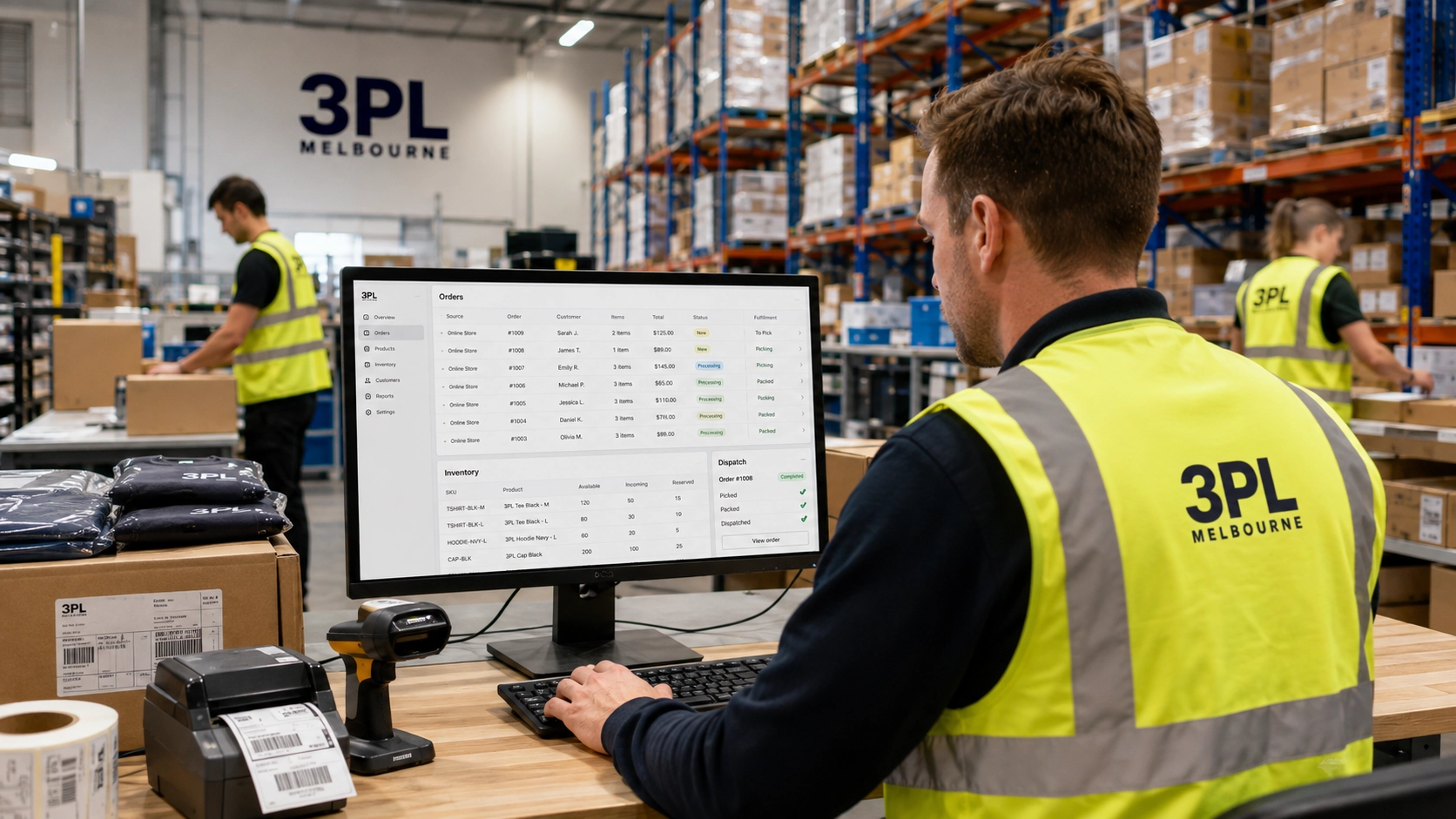
Connecting a Shopify store to a third-party logistics provider sounds straightforward.
A customer places an order. The warehouse receives it. The order gets shipped.
And at the simplest level, that is what should happen.
But a good Shopify fulfilment setup does considerably more than forward an order confirmation from one system to another.
The objective is to create a connected process in which your online store and physical inventory remain aligned from the moment a customer buys through to the moment their parcel leaves the warehouse.
Here is what businesses should expect that process to achieve.
1. Orders should reach the warehouse without somebody re-entering them
Manual order processing introduces unnecessary work and unnecessary opportunities for error.
When Shopify and your fulfilment operation are connected correctly, eligible orders should move into the warehouse workflow without someone downloading spreadsheets, forwarding emails or copying addresses between systems.
That matters even at relatively modest volumes.
At ten orders a day, manual handling can be inconvenient.
At 100 or 500 orders a day, it can become an operational bottleneck.
Automation allows the warehouse team to focus on fulfilling the order rather than recreating it.
2. The correct order information needs to travel with it
Sending an order number is not enough.
The fulfilment operation needs the information required to execute the order correctly.
Depending on the retailer, that can include:
- Customer delivery details
- SKU and product information
- Quantity
- Shipping method
- Order priority
- Packaging requirements
- Promotional inserts
- Bundles or kits
- Relevant order notes
The aim is to reduce the amount of interpretation required inside the warehouse.
The clearer the information arriving with each order, the easier it is to build a consistent process around it.
3. Inventory needs to remain visible
An eCommerce store can only sell confidently when the stock information behind it is reliable.
The warehouse needs to know what inventory it has received, where that stock is located and what has already been allocated or dispatched.
The retailer, meanwhile, needs visibility of what is available to sell.
That makes inventory management one of the most important parts of an eCommerce fulfilment operation.
A good process should minimise situations where the website and warehouse are effectively working from two different versions of the truth.
4. Picking should be driven by accurate product data
This is where digital information becomes physical work.
The warehouse team needs to identify the right SKU, retrieve the correct quantity and prepare it for the customer.
Good product data makes that much easier.
Clear SKU structures are particularly important when a retailer has products that look similar, multiple sizes or colours, bundles or frequent product launches.
If the product catalogue is messy before the integration begins, connecting it to a 3PL will not magically fix it.
One of the most useful things a retailer can do before outsourcing is clean up the way products and SKUs are structured.
5. Packaging rules should be clear
Not every Shopify order should necessarily be packed in exactly the same way.
A brand may have:
- Different carton sizes
- Fragile products
- Premium packaging
- Promotional inserts
- Gift messages
- Product bundles
- Samples
- Campaign-specific collateral
These requirements need to become operating rules rather than information that lives in someone’s head.
The more frequently a brand runs promotions or changes its presentation, the more important this becomes.
6. The right delivery service needs to be selected
Once the order is packed, the fulfilment process moves into freight.
The shipping method selected at checkout needs to translate into the appropriate warehouse and carrier workflow.
That may be relatively simple for a business offering one delivery service.
It becomes more important when customers can choose between standard, express or other delivery options.
Incorrect shipping logic creates one of two outcomes: the business pays more freight than necessary, or the customer receives a different service from the one they selected.
Neither is ideal.
7. Dispatch information should flow back to the store
The connection should not stop when the order reaches the warehouse.
Once the parcel has been dispatched, the relevant status and tracking information should flow back through the eCommerce process so the customer can be kept informed.
From the customer’s perspective, this should feel like one continuous experience.
They do not care that the website, warehouse and carrier may all be separate organisations and systems.
They simply expect the retailer to know where their order is.
8. Exceptions still need people
Automation is extremely useful.
It is not the same thing as eliminating operational judgement.
Orders can contain incorrect addresses. Stock can arrive damaged. A promotion can be configured incorrectly. A customer can make a last-minute request.
A strong fulfilment arrangement combines systems with people who know what to do when something falls outside the normal process.
That is why the quality of the relationship with a 3PL still matters even when most routine activity is automated.
Before connecting Shopify to a 3PL
Businesses can make integration considerably easier by getting a few basics right first.
Review your SKU structure.
Make sure product dimensions and weights are accurate where required.
Document packaging and shipping rules.
Identify any bundles or special-order types.
Decide how returns should be handled.
Clarify which system will be treated as the source of truth for different information.
And test the complete order journey before going live.
Do not stop testing when the order appears in the warehouse system.
Follow it all the way through picking, packing, dispatch, tracking and inventory updates.
Integration should remove work, not simply move it
A poor systems setup can leave a retailer with a technically “integrated” warehouse while staff continue manually fixing orders and reconciling information every day.
That defeats much of the point.
The goal is a fulfilment process where routine orders move cleanly from sale to dispatch, inventory remains visible and exceptions can be identified and managed quickly.
When that happens, the technology largely disappears into the background.
The retailer can focus on selling.
The warehouse can focus on fulfilling.
And the customer receives the order they expected.
If you’re planning to connect your Shopify store to an outsourced fulfilment operation, talk to 3PL Melbourne about the order, inventory, packaging and dispatch requirements that need to be considered before you go live.
3. WooCommerce Fulfilment: 7 Things to Get Right Before You Outsource Your Logistics
Meta description:
Planning to outsource WooCommerce fulfilment? Get these seven areas right before connecting your store to a 3PL, from SKUs to shipping and returns.
Social share title:
Outsourcing WooCommerce Fulfilment? Start Here
Social share description:
Before your WooCommerce store connects to a 3PL, make sure your products, inventory, shipping rules and returns process are ready.
Image direction: Consumer / retailer
Image prompt:
Photorealistic 16:9 commercial eCommerce brand image for 3PL Melbourne. Show a sophisticated Australian online retailer preparing to outsource fulfilment from a bright modern office, showroom or product studio. A Caucasian/European-looking business owner or ecommerce manager is working at a laptop displaying a clean WooCommerce-style product and order dashboard without directly reproducing proprietary UI. Nearby are beautifully presented consumer products, neatly labelled SKUs, several premium shipping cartons and a small organised inventory shelving area. Include a colleague checking a product or packing list in the background to suggest the business has grown beyond one person. The image should communicate a successful online brand reaching the point where logistics needs to become more structured. Bright natural light, elegant clean styling, contemporary Melbourne small-business feel, aspirational but realistic, no warehouse high-vis, no excessive boxes, no generic corporate meeting scene, no text overlays. Consistent with the existing 3PL Melbourne blog imagery.
WooCommerce Fulfilment: 7 Things to Get Right Before You Outsource Your Logistics
WooCommerce gives online retailers an enormous amount of flexibility.
That is one of its biggest advantages.
It can also make fulfilment more complicated when a business has spent several years adding products, plugins, shipping rules and customised processes as it grows.
When orders are being packed internally, staff often learn to work around those quirks.
The person preparing an order may simply know that a particular product requires a larger carton, that two SKUs are always bundled together or that one shipping option needs to be handled differently.
Once fulfilment moves to a 3PL, those informal workarounds need to become clear processes.
If you’re preparing to outsource WooCommerce fulfilment, here are seven things worth sorting out first.
1. Clean up your SKU structure
Your warehouse needs a reliable way to identify every product it handles.
That begins with SKUs.
Each sellable product variation should have a clear and unique identifier.
If the same SKU has accidentally been reused across several products, or some products have no SKU at all, this is the time to fix it.
This is especially important for retailers selling products with multiple:
- Sizes
- Colours
- Styles
- Pack sizes
- Variants
What seems obvious when looking at a product photograph may not be obvious when someone is standing in front of a warehouse location containing several similar items.
Clear product identification supports accurate picking.
2. Work out exactly what stock is available to sell
Inventory becomes much more important once your website and warehouse need to remain aligned.
Before moving to a 3PL, understand how WooCommerce currently determines stock availability.
Are all products inventory-controlled?
Are any products allowed to oversell?
Do bundles share components with individually sold products?
Are there virtual products or items fulfilled by another supplier?
Do you accept pre-orders?
The fulfilment partner needs to understand which orders it is responsible for and how stock should behave when products are received, allocated, sold, returned or adjusted.
3. Document bundles, kits and promotions
This catches many growing retailers out.
The website may sell one “product” that is actually made up of several physical items in the warehouse.
For example, a skincare set could contain three individual products.
A promotional pack could contain a product plus a sample and printed insert.
A subscription or gift box may require several SKUs to be assembled together.
Those arrangements need to be clearly defined before fulfilment is outsourced.
The same applies to promotional rules.
If every order over a certain value receives a free gift, the warehouse needs a reliable way of identifying those orders.
A promotion that works perfectly on the website is only successful if the physical fulfilment process understands it too.
4. Simplify your shipping rules
WooCommerce stores can accumulate surprisingly complicated shipping configurations.
Different services may apply according to postcode, basket value, weight, product type or customer selection.
Before integrating with a 3PL, review what is genuinely necessary.
Ask:
What delivery options do customers see?
What does each one actually promise?
Which carrier or service should fulfil each option?
Are there product types that require different handling?
Are any outdated shipping methods still sitting in the store?
The aim is not necessarily to remove choice.
It is to make sure each customer-facing shipping option translates into an operational instruction that can be fulfilled consistently.
5. Decide what your packaging rules are
Packaging can become very subjective when orders are packed internally.
One person may use a small carton. Another chooses a satchel. Someone else adds extra protective material because they know the product.
A 3PL needs clearer instructions.
Consider:
- Available carton and satchel sizes
- Product protection requirements
- Branded packaging
- Tissue or presentation
- Inserts
- Samples
- Gift notes
- Fragile items
- Sustainable packaging preferences
Try to turn these into repeatable rules.
That delivers more consistent results and makes it easier to understand the true cost of fulfilment.
6. Plan your returns process before launch
It is easy to devote all your attention to getting orders out of the warehouse.
You also need to decide what happens when products come back.
Who authorises a return?
Where is it sent?
What information accompanies it?
When a returned product arrives, should it be placed back into available stock?
Does it require inspection?
What happens to damaged goods?
How is the inventory adjustment recorded?
The answer will depend on the retailer and product category, but the process should be agreed before the first return arrives at the 3PL.
7. Test real-world orders, not just the connection
A successful test should prove more than the fact that WooCommerce can send an order to another system.
Create examples of the orders your customers actually place.
Test:
- A normal single-product order
- A multi-item order
- Different product variants
- A promotional order
- A bundle
- Different shipping services
- An order containing a customer note if relevant
- A cancellation or exception
- A dispatch and tracking update
Then confirm that inventory behaves correctly throughout the process.
This is the difference between testing the technology and testing the fulfilment operation.
You need both.
Your website has flexibility. Your warehouse needs clarity.
WooCommerce allows retailers to customise almost every aspect of the shopping experience.
That does not mean fulfilment should become equally complicated.
In fact, outsourcing is often a useful opportunity to simplify.
Document the rules that matter.
Remove outdated workarounds.
Clean up product data.
Agree how inventory, shipping, packaging and returns should operate.
The simpler and clearer those processes are, the easier it becomes for a 3PL to execute them reliably as order volumes grow.
Do the preparation before stock moves
The best time to discover an issue with a SKU, bundle or shipping rule is before hundreds of orders are flowing through the warehouse.
A little preparation at the beginning can prevent a great deal of manual intervention later.
For an eCommerce business, that is ultimately what good fulfilment should provide: a repeatable operating process that allows orders to keep moving without the founders or internal team needing to supervise every parcel.
Thinking about outsourcing WooCommerce fulfilment? 3PL Melbourne can help you work through the practical warehouse, inventory and order requirements involved in moving fulfilment to a specialist provider.
More fulfilment guides
Keep reading
Related articles and useful next reads for online retailers learning how fulfilment works.

3PL basics, Customer experience
How Poor Logistics Damages the Customer Experience
Slow dispatch, damaged packaging and difficult returns can quickly undermine a strong brand. Learn how poor logistics affects reviews, loyalty and repeat business.