

blog/
How 3PL Works, Shopify
Shopify Fulfilment: What Your 3PL Integration Should Actually Do
Practical articles for online retailers who want to understand 3PL, improve fulfilment and know when it is time to hand over the work after checkout.
By
3PL Melbourne
Date
Oct 2026
Read time
5 minutes
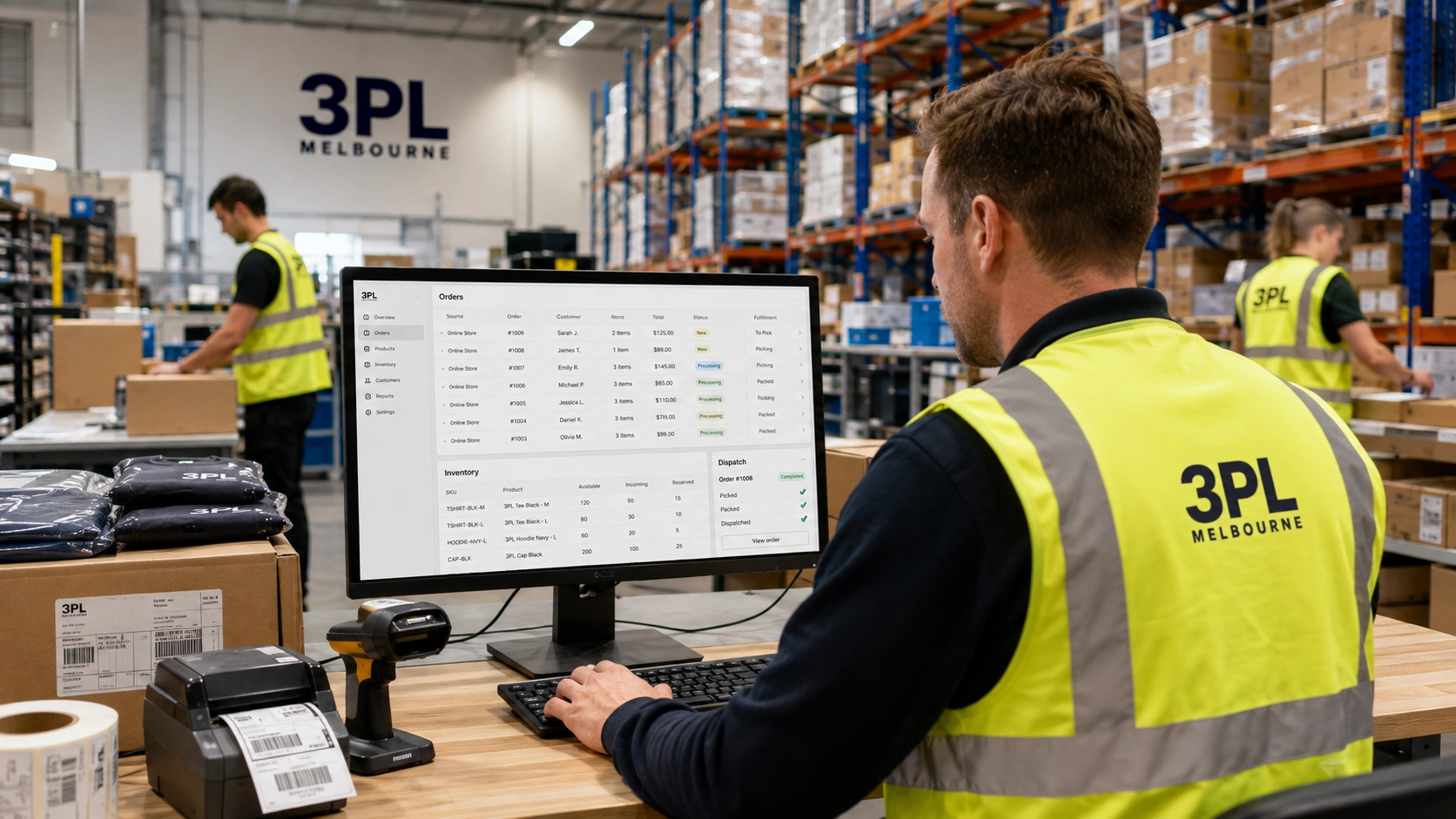
Connecting a Shopify store to a third-party logistics provider sounds straightforward. A customer places an order. The warehouse receives it. The order gets shipped. And at the simplest level, that is what should happen. But a good Shopify fulfilment setup does considerably more than forward an order confirmation from one system to another. The objective is to create a connected process in which your online store and physical inventory remain aligned from the moment a customer buys through to the moment their parcel leaves the warehouse. Here is what businesses should expect that process to achieve:
1. Orders should reach the warehouse without somebody re-entering them
Manual order processing introduces unnecessary work and unnecessary opportunities for error. When Shopify and your fulfilment operation are connected correctly, eligible orders should move into the warehouse workflow without someone downloading spreadsheets, forwarding emails or copying addresses between systems. That matters even at relatively modest volumes. At ten orders a day, manual handling can be inconvenient. At 100 or 500 orders a day, it can become an operational bottleneck. Automation allows the warehouse team to focus on fulfilling the order rather than recreating it.
2. The correct order information needs to travel with it
Sending an order number is not enough. The fulfilment operation needs the information required to execute the order correctly. Depending on the retailer, that can include:
- Customer delivery details
- SKU and product information
- Quantity
- Shipping method
- Order priority
- Packaging requirements
- Promotional inserts
- Bundles or kits
- Relevant order notes
The aim is to reduce the amount of interpretation required inside the warehouse. The clearer the information arriving with each order, the easier it is to build a consistent process around it.
3. Inventory needs to remain visible
An eCommerce store can only sell confidently when the stock information behind it is reliable. The warehouse needs to know what inventory it has received, where that stock is located and what has already been allocated or dispatched. The retailer, meanwhile, needs visibility of what is available to sell. That makes inventory management one of the most important parts of an eCommerce fulfilment operation. A good process should minimise situations where the website and warehouse are effectively working from two different versions of the truth.
4. Picking should be driven by accurate product data
This is where digital information becomes physical work. The warehouse team needs to identify the right SKU, retrieve the correct quantity and prepare it for the customer. Good product data makes that much easier. Clear SKU structures are particularly important when a retailer has products that look similar, multiple sizes or colours, bundles or frequent product launches. If the product catalogue is messy before the integration begins, connecting it to a 3PL will not magically fix it. One of the most useful things a retailer can do before outsourcing is clean up the way products and SKUs are structured.
5. Packaging rules should be clear
Not every Shopify order should necessarily be packed in exactly the same way. A brand may have:
- Different carton sizes
- Fragile products
- Premium packaging
- Promotional inserts
- Gift messages
- Product bundles
- Samples
- Campaign-specific collateral
These requirements need to become operating rules rather than information that lives in someone’s head. The more frequently a brand runs promotions or changes its presentation, the more important this becomes.
6. The right delivery service needs to be selected
Once the order is packed, the fulfilment process moves into freight. The shipping method selected at checkout needs to translate into the appropriate warehouse and carrier workflow. That may be relatively simple for a business offering one delivery service. It becomes more important when customers can choose between standard, express or other delivery options. Incorrect shipping logic creates one of two outcomes: the business pays more freight than necessary, or the customer receives a different service from the one they selected. Neither is ideal.
7. Dispatch information should flow back to the store
The connection should not stop when the order reaches the warehouse. Once the parcel has been dispatched, the relevant status and tracking information should flow back through the eCommerce process so the customer can be kept informed. From the customer’s perspective, this should feel like one continuous experience. They do not care that the website, warehouse and carrier may all be separate organisations and systems. They simply expect the retailer to know where their order is.
8. Exceptions still need people
Automation is extremely useful. It is not the same thing as eliminating operational judgement. Orders can contain incorrect addresses. Stock can arrive damaged. A promotion can be configured incorrectly. A customer can make a last-minute request. A strong fulfilment arrangement combines systems with people who know what to do when something falls outside the normal process. That is why the quality of the relationship with a 3PL still matters even when most routine activity is automated.
Before connecting Shopify to a 3PL
Businesses can make integration considerably easier by getting a few basics right first. Review your SKU structure. Make sure product dimensions and weights are accurate where required. Document packaging and shipping rules. Identify any bundles or special-order types. Decide how returns should be handled. Clarify which system will be treated as the source of truth for different information. And test the complete order journey before going live.
Do not stop testing when the order appears in the warehouse system. Follow it all the way through picking, packing, dispatch, tracking and inventory updates.
Integration should remove work, not simply move it
A poor systems setup can leave a retailer with a technically “integrated” warehouse while staff continue manually fixing orders and reconciling information every day. That defeats much of the point. The goal is a fulfilment process where routine orders move cleanly from sale to dispatch, inventory remains visible and exceptions can be identified and managed quickly. When that happens, the technology largely disappears into the background. The retailer can focus on selling. The warehouse can focus on fulfilling. And the customer receives the order they expected.
If you’re planning to connect your Shopify store to an outsourced fulfilment operation, talk to 3PL Melbourne about the order, inventory, packaging and dispatch requirements that need to be considered before you go live
More fulfilment guides
Keep reading
Related articles and useful next reads for online retailers learning how fulfilment works.
3PL basics, How 3PL Works, Outsourcing Fulfilment