

blog/
3PL basics, Shopify
When Is It Time to Connect Your Shopify Store to a 3PL?
Practical articles for online retailers who want to understand 3PL, improve fulfilment and know when it is time to hand over the work after checkout.
By
3PL Melbourne
Date
Aug 2026
Read time
5 minutes
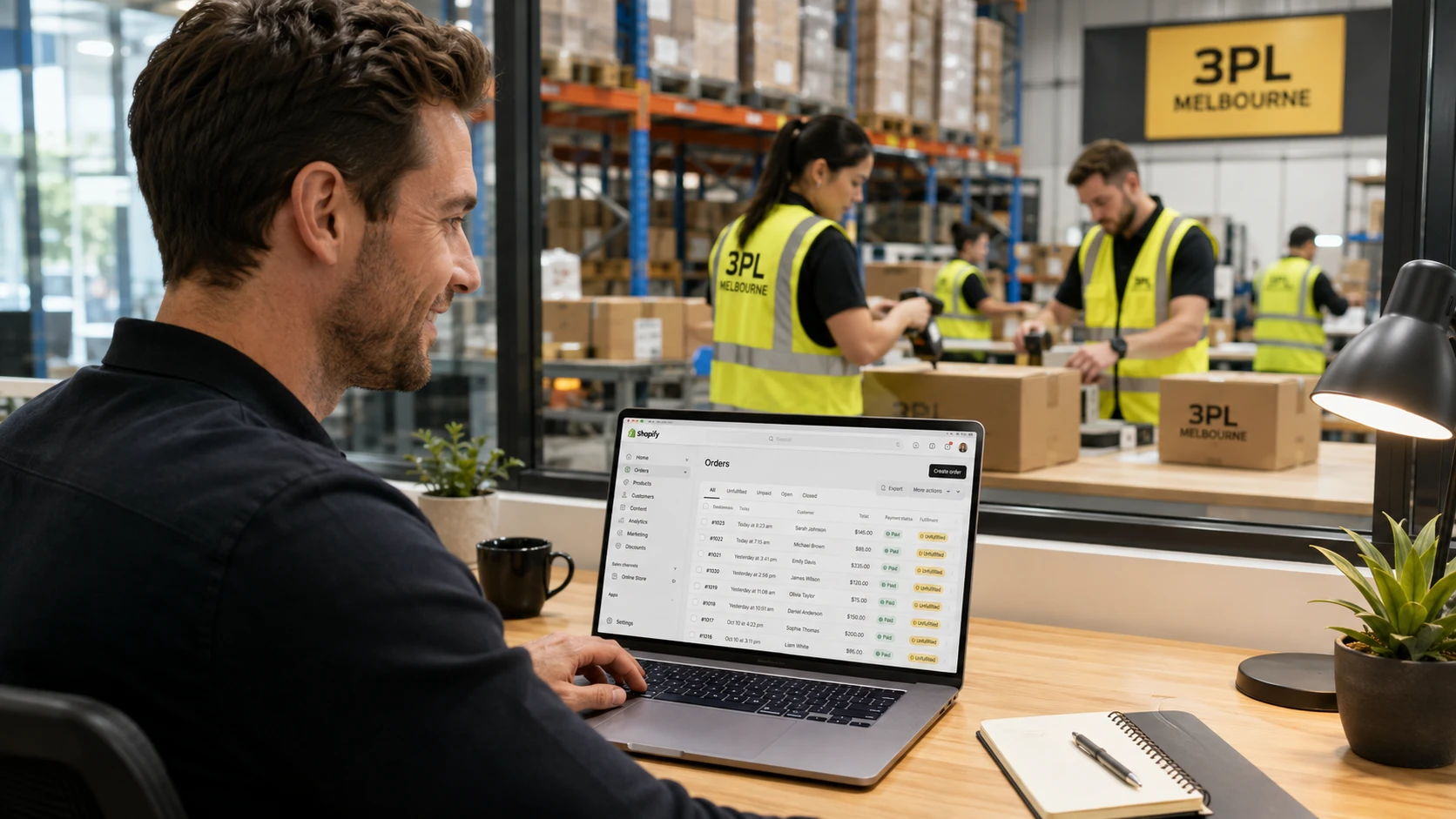
Shopify makes it relatively easy to start and grow an online store.
You can add products, accept payments, run promotions and manage customer orders from one platform. In the early stages of a business, it may also be practical to manage fulfilment yourself.
Stock might be stored in a spare room, office, retail store or small warehouse. When an order arrives, someone prints the paperwork, finds the product, packs the parcel and arranges delivery.
That approach can work well—until sales begin to grow.
As order volumes increase, fulfilment starts requiring more space, labour, systems and management attention. Inventory becomes harder to track. Dispatch deadlines become more difficult to meet. Promotions create sudden peaks, and internal teams spend increasing amounts of time packing orders rather than growing the business.
Connecting a Shopify store to a third-party logistics provider, commonly known as a 3PL, can help create a more scalable operating model.
The 3PL stores the retailer’s inventory and manages the physical fulfilment process, while Shopify continues to manage the online store and customer orders.
The result should be a connected workflow in which orders move from Shopify to the warehouse, products are picked and packed, and fulfilment information is returned to the store.
So, how does Shopify fulfilment work with a 3PL, and when is it time to make the move?
What is Shopify fulfilment?
Shopify fulfilment is the process of preparing and dispatching the physical products customers purchase through a Shopify store.
It generally includes:
- receiving the customer’s order;
- confirming that stock is available;
- locating the correct product;
- picking the required quantity;
- packing the order;
- creating shipping documentation;
- arranging delivery;
- adding tracking information;
- updating the order as fulfilled;
- managing any subsequent return.
Shopify allows merchants to configure the locations where inventory is stored and orders are fulfilled. Order-routing rules can then determine which location should fulfil an order, based on factors such as inventory availability or proximity to the customer. Shopify also supports third-party fulfilment services that store stock and ship orders on the retailer’s behalf.
The retailer still controls the Shopify store, products, pricing, promotions and customer relationships.
The 3PL manages the physical work required to get the order out of the warehouse and into the customer’s hands.
How does Shopify connect to a 3PL?
The exact process depends on the warehouse systems and integration used, but the basic workflow is straightforward.
1. The customer places an order
A customer purchases through the retailer’s Shopify store.
The order contains the information needed for fulfilment, such as:
- the products ordered;
- quantities;
- customer details;
- delivery address;
- shipping method;
- order notes;
- relevant tags or instructions.
2. The order is sent to the warehouse
The Shopify store and the 3PL’s warehouse management system are connected through an app, integration or fulfilment service.
Shopify supports third-party fulfilment providers and can allow retailers to manage fulfilment workflows from the Shopify admin. It also supports app-based fulfilment requests and custom fulfilment services.
The warehouse receives the order without the retailer needing to download a spreadsheet or re-enter the details manually.
3. The warehouse picks and packs the order
The warehouse team locates the relevant products and checks that the correct items and quantities have been selected.
The order is then packed according to the retailer’s instructions.
These may include:
- specific cartons or satchels;
- product protection;
- branded tissue or stickers;
- thank-you cards;
- samples;
- promotional inserts;
- gift wrapping;
- bundles or multipacks;
- special handling requirements.
4. The order is dispatched
The 3PL prepares the shipping label and assigns the parcel to an appropriate delivery service.
Once the order is dispatched, the fulfilment status and tracking information can be returned to Shopify.
The customer can then receive a dispatch notification and follow the progress of the delivery.
5. Inventory is adjusted
As products are allocated and dispatched, inventory levels are updated.
This is one of the most important parts of the connection.
The Shopify store needs an accurate view of available stock so customers are not purchasing products that the warehouse cannot fulfil.
Why manual Shopify fulfilment becomes difficult
Manual fulfilment can be effective at low volumes.
However, it becomes harder to maintain as the business grows.
A retailer may begin by reviewing each order in Shopify, printing a picking list, finding the products and entering tracking details manually.
At higher volumes, that process can create several risks.
Orders can be missed
When orders need to be exported, emailed or entered into another system, there is a greater chance that one may be overlooked.
Information can be entered incorrectly
Manual entry creates opportunities for mistakes in:
- product codes;
- quantities;
- addresses;
- shipping methods;
- tracking numbers.
Dispatch updates can be delayed
If tracking information is not returned promptly to Shopify, customers may not know whether their order has been sent.
This can increase customer service enquiries.
Inventory can become inaccurate
If stock is adjusted in the warehouse but not reflected correctly in Shopify, the store may continue selling unavailable products.
Growth creates additional administration
The process that takes one person an hour at low volume may require several people as order numbers increase.
At that point, the business is not only packing more parcels. It is also managing more data, exceptions and customer expectations.
A proper integration helps reduce this duplication by connecting the online store to the physical fulfilment operation.
Inventory needs to remain aligned
Inventory accuracy is fundamental to Shopify fulfilment.
Shopify allows retailers to track inventory, view stock levels, make adjustments and review inventory changes. It also supports inventory across multiple locations and fulfilment services.
The practical challenge is ensuring that the stock shown online matches what is physically available in the warehouse.
Several inventory states may need to be understood:
- Stock on hand: the total quantity physically held.
- Available stock: inventory that can currently be sold.
- Committed stock: products allocated to existing orders.
- Incoming stock: goods expected from suppliers.
- Unavailable stock: damaged, quarantined or otherwise unsuitable for sale.
A retailer may physically have 100 units in the warehouse, but that does not necessarily mean all 100 should be available for customers to purchase.
Some may already be committed to orders. Others may be damaged, held for wholesale customers or included in pre-assembled kits.
The Shopify and warehouse setup needs to reflect the retailer’s actual inventory rules.
What happens when you use multiple locations?
Some Shopify retailers fulfil orders from more than one location.
For example, a business may have:
- a 3PL warehouse;
- a retail store;
- an office;
- a second warehouse;
- stock held by another fulfilment service.
Shopify can manage inventory across multiple locations and use order-routing rules to determine which location should fulfil each order. Retailers can also choose whether inventory at a particular location should be used for online fulfilment.
This can create flexibility, but it also needs to be configured carefully.
The business should decide:
- which locations are allowed to fulfil online orders;
- whether one location has priority;
- what happens when products are split across locations;
- whether orders can be divided into multiple shipments;
- how transfers between locations are recorded;
- which location handles returns;
- how delivery rates differ by location.
A 3PL integration should be planned around these decisions rather than connected without a clear fulfilment model.
Shopify bundles need special attention
Bundles are popular because they can increase order value, support promotions and make it easier to sell complementary products together.
Shopify’s first-party Bundles app supports fixed bundles and multipacks from within the Shopify admin.
However, bundles create additional warehouse requirements.
A bundle may exist online as one sellable product, while the warehouse needs to pick several individual components.
For example, a skincare bundle may contain:
- one cleanser;
- one moisturiser;
- one serum;
- one branded pouch;
- one instruction card.
The retailer and 3PL need to agree whether the bundle will be:
- assembled in advance and stored as one finished product;
- assembled only when an order is received;
- packed using individual components with a bundle-specific instruction.
Inventory also needs to be managed at component level.
If the serum is unavailable, the full skincare bundle may need to become unavailable—even when the other items remain in stock.
This is why bundles should be tested carefully before a promotion goes live.
Promotions can create sudden fulfilment pressure
Shopify makes it easy to create discounts and offers.
Retailers may run:
- percentage discounts;
- fixed-price offers;
- buy-one-get-one promotions;
- product bundles;
- free shipping;
- seasonal campaigns;
- product launches.
Shopify supports “Buy X, get Y” promotions and notes that they can be used to encourage sales, reward customers or move slower stock.
From a fulfilment perspective, the campaign needs more preparation than simply switching on the discount.
Before launching, the retailer should confirm:
- sufficient inventory is physically available;
- Shopify stock records are accurate;
- the 3PL knows the campaign dates;
- any bundles have been configured correctly;
- promotional inserts are at the warehouse;
- packaging materials are available;
- expected order volumes have been shared;
- dispatch expectations are realistic;
- carrier capacity has been considered.
Marketing can create demand almost instantly.
The warehouse cannot always create additional labour, packing stock or inventory with the same speed.
A good Shopify–3PL relationship therefore depends on communication, not only technology.
Returns must also connect back to the business
The fulfilment process does not always end at delivery.
Customers may return products because:
- the item is the wrong size;
- they changed their mind;
- the product arrived damaged;
- the incorrect item was sent;
- the product did not meet expectations.
A 3PL can receive and assess returned items according to agreed rules.
The warehouse may:
- identify the original order;
- record the returned product;
- inspect its condition;
- return suitable items to stock;
- quarantine damaged products;
- report missing components;
- notify the retailer.
The retailer usually retains control over the customer-facing decision, such as approving a refund, exchange or replacement.
Shopify supports refunds from the order record, while the physical return still needs to be reconciled with the warehouse inventory.
The important point is that the financial transaction and physical stock movement need to remain aligned.
A refund should not automatically make a product available for resale if the item has not yet been returned or inspected.
What information should move between Shopify and the warehouse?
A successful integration should provide the information required to fulfil the order accurately without transferring unnecessary or confusing data.
The warehouse may need:
- Shopify order number;
- product SKU;
- product description;
- variant information;
- quantity;
- delivery address;
- selected shipping method;
- customer notes;
- order tags;
- gift instructions;
- bundle details;
- promotional requirements.
Shopify may need to receive:
- fulfilment status;
- dispatch date;
- tracking number;
- carrier information;
- cancelled or rejected fulfilment status;
- inventory changes;
- exception information.
The exact data flow depends on the systems and agreed process.
Before launch, the retailer should test a range of orders, including:
- a standard single-item order;
- a multi-item order;
- a bundle;
- a discounted order;
- a gift order;
- an express order;
- an order with special notes;
- an order that is cancelled;
- a return.
Testing ordinary and unusual scenarios reduces the likelihood of discovering workflow problems after real customer orders begin arriving.
When is it time to connect Shopify to a 3PL?
There is no universal order volume at which every Shopify retailer should outsource fulfilment.
The right time depends on:
- product size;
- number of SKUs;
- average items per order;
- storage requirements;
- margins;
- internal labour;
- seasonal demand;
- growth plans.
However, there are several clear signs that the current model is becoming restrictive.
1. Stock is taking over the business
Products and packaging materials may be occupying the office, retail store, spare room or garage.
The business continually needs more storage, and stock is becoming difficult to organise.
2. Too much time is spent packing orders
The founder or internal team is regularly pulled away from marketing, product development, sales or customer service to manage fulfilment.
3. Orders are leaving late
The team is struggling to meet dispatch commitments, particularly after weekends, promotions or seasonal peaks.
4. Inventory is becoming unreliable
Shopify says a product is available, but the team cannot find it—or the physical quantity does not match the system.
5. Manual administration is increasing
Orders, tracking numbers and stock adjustments are being copied between systems or managed through spreadsheets.
6. Promotions are difficult to fulfil
Campaign success creates a warehouse problem rather than a commercial opportunity.
7. The business needs more staff or space
Continuing internally would require a larger lease, warehouse equipment, recruitment and operational management.
8. Fulfilment errors are affecting customers
Incorrect products, damaged parcels or delayed orders are generating complaints and replacement costs.
9. The business is expanding into more channels
The retailer needs one coordinated inventory and fulfilment process across Shopify, marketplaces, retail or wholesale orders.
10. Growth is being limited by logistics
The business is avoiding promotions, new products or sales opportunities because the team cannot confidently manage additional orders.
These signs suggest that fulfilment is no longer a small administrative task. It has become an operational capability requiring dedicated infrastructure, systems and people.
What should you ask a Shopify 3PL provider?
Not every warehouse that says it supports Shopify will provide the same level of integration or service.
Before choosing a provider, ask:
- How does your Shopify integration work?
- Which data moves between Shopify and your warehouse system?
- How quickly are orders received?
- How are fulfilled orders and tracking details returned?
- How is inventory synchronised?
- Can you support multiple Shopify locations?
- How do you manage bundles and multipacks?
- Can you process subscriptions or pre-orders?
- How are cancelled orders handled?
- What happens if an address changes after the order arrives?
- How do you manage returns?
- Can you follow branded packing instructions?
- How are promotions and order spikes planned?
- What reporting will we receive?
- Who manages integration problems?
- Are there setup, app or transaction fees?
- What happens if the integration temporarily fails?
The provider should be able to explain the process in practical terms.
A vague promise that “Shopify connects” is not enough.
The retailer needs to understand what happens from the moment a customer clicks Buy until the parcel leaves the warehouse.
Prepare your Shopify store before integration
A 3PL integration works best when the product and inventory data are already well organised.
Before connecting, review:
Product SKUs
Every product and variant should have a clear, unique SKU.
Similar or duplicated SKUs can create picking and inventory problems.
Product variants
Sizes, colours and other variants should be set up consistently.
The warehouse needs to distinguish between products that may look almost identical.
Barcodes
Where barcodes are used, they should match the physical products received at the warehouse.
Product weights and dimensions
Accurate information supports packaging and freight decisions.
Inventory settings
The business should decide which location owns each stock quantity and whether backorders or continued selling when out of stock are permitted.
Shipping methods
Shopify shipping options should map clearly to the delivery services the 3PL will use.
Order tags and notes
Any rules based on tags, gift status or campaign source should be documented and tested.
Bundles
The retailer and warehouse should agree how each bundle is assembled and how component inventory is managed.
Returns rules
The provider needs clear instructions for restockable, damaged, incomplete and review-required items.
Cleaning up this information before integration can prevent significant operational confusion later.
A 3PL does not replace business planning
Connecting Shopify to a 3PL can automate much of the fulfilment workflow, but it does not remove the retailer’s responsibilities.
The business still needs to:
- forecast demand;
- purchase stock;
- manage suppliers;
- communicate promotions;
- approve packaging;
- define returns rules;
- monitor performance;
- resolve customer issues;
- plan future growth.
The 3PL provides the physical infrastructure and operational execution.
Shopify provides the online commerce platform.
The retailer remains responsible for connecting the two through clear decisions, accurate information and ongoing communication.
The goal is a better customer experience
Customers do not care which system sends an order to the warehouse.
They care that:
- the correct product is available;
- the order is processed promptly;
- tracking is provided;
- the parcel arrives safely;
- the presentation reflects the brand;
- returns are manageable.
A well-designed Shopify fulfilment process helps deliver those outcomes consistently.
The technology should reduce manual work and improve visibility. The warehouse should provide accurate, dependable execution. The retailer should be able to grow without every additional order creating more internal pressure.
Make Shopify growth easier to fulfil
A Shopify store can generate sales at any time, but every physical order still needs to be stored, picked, packed and delivered.
As order volumes rise, connecting the store to a 3PL can provide the systems, warehouse space and operational capacity required to support continued growth.
The right provider should make fulfilment simpler—not create another disconnected process for the retailer to manage.
3PL Melbourne provides Shopify fulfilment, secure warehousing, inventory management, pick and pack, freight and returns support for established Australian eCommerce businesses.
Call 1300 337 100 to discuss connecting your Shopify store to a fulfilment operation that can grow with your business.
More fulfilment guides
Keep reading
Related articles and useful next reads for online retailers learning how fulfilment works.
3PL basics, How 3PL Works, Outsourcing Fulfilment